
Observed actions
Inputs, candidates, corrections, Undo/Redo, and Coach use are treated as observed actions from actual play.
OORIO SUDOKU · IN DEVELOPMENT
Solve with logic rather than luck, then review the evidence your play leaves behind.
AI + HUMAN REASONING
AI can calculate, search, organize, and produce answers quickly. oorio does not argue for using less AI. It keeps room for people to observe, compare, narrow possibilities, check evidence, and make decisions themselves.
Sudoku uses numbers, but it is not arithmetic. You inspect what is possible on the board, compare candidates, eliminate what cannot fit, make a choice, and verify it.
Instead of asking AI for the answer, spend a moment building the answer yourself. oorio Sudoku focuses on that process.
WHY OORIO SUDOKU
SUDOKU THAT REMEMBERS HOW YOU REASON
After the last digit, you can still see where you hesitated, which candidates you compared, when a decision went wrong, and how you recovered.
Rather than listing every tap, oorio separates meaningful decision scenes from the full solve Timeline.
KEY DECISION SCENES
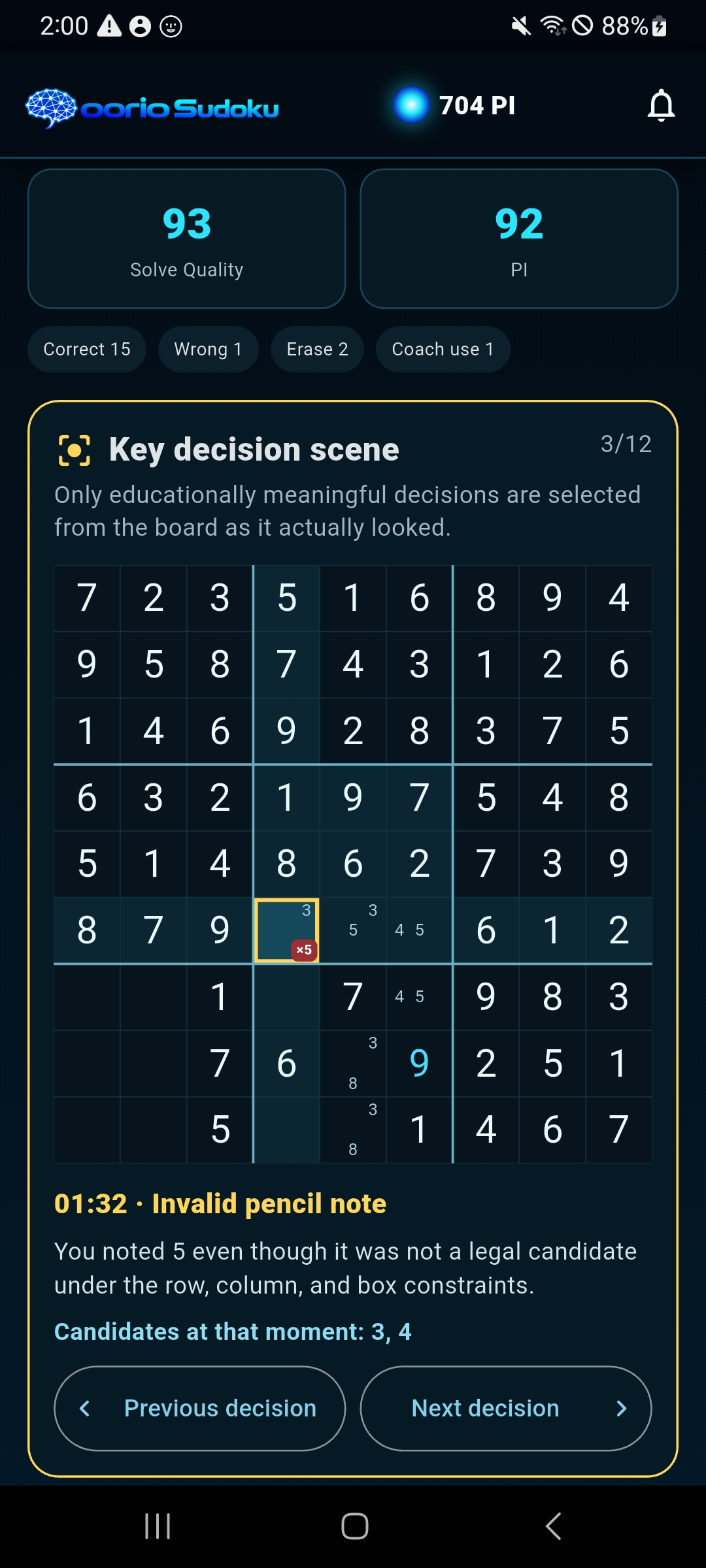
Key moments include a wrong placement, a sharply narrowed candidate set, or a turn that changed the direction of the solve.
Review the row, column, 3×3 box, candidates, choice, and what changed next on the board as it looked at that moment.
DETAILED SOLVE ANALYSIS
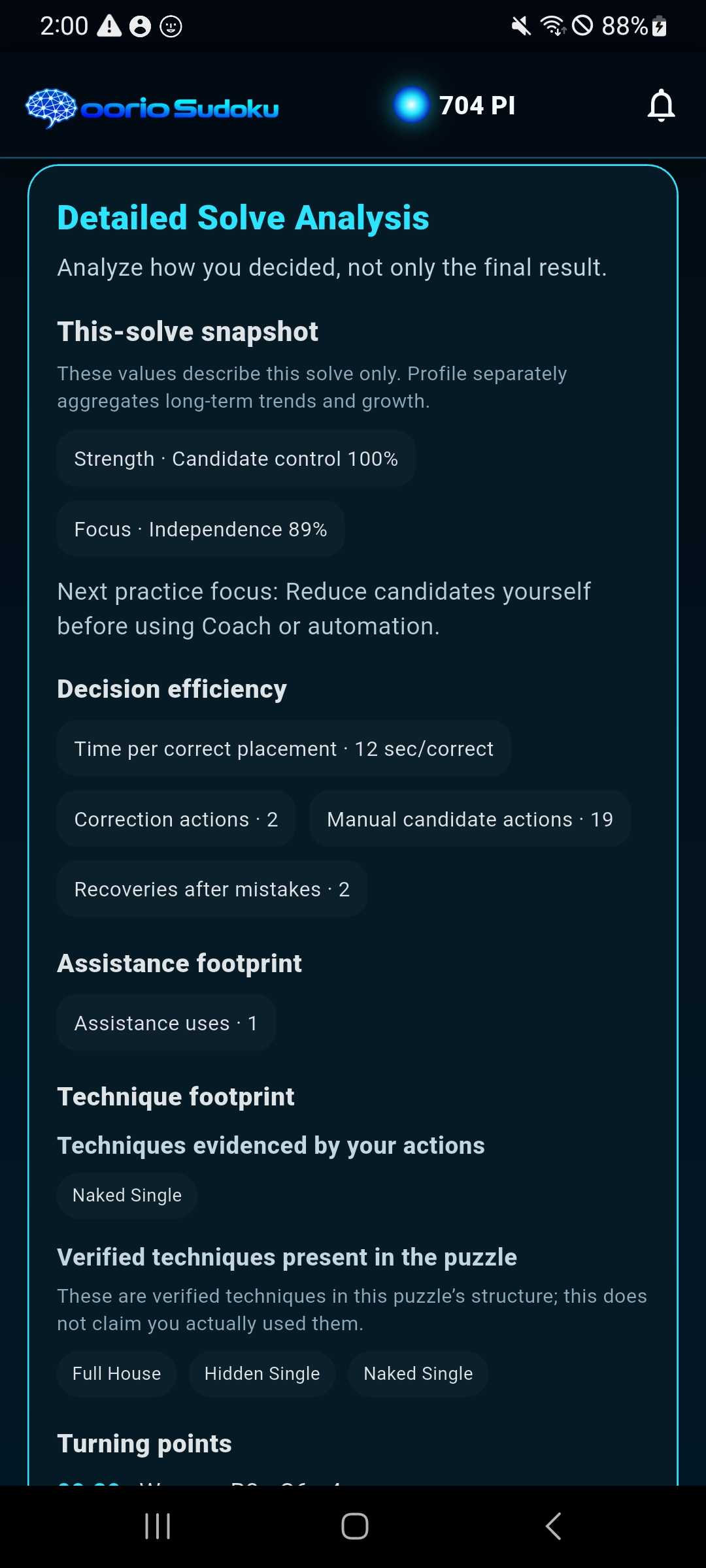
Accuracy, independent solving, candidate control, and solve quality are summarized from actual play. Time per correct placement, corrections, manual candidate actions, recovery after mistakes, and Coach use add context.
Inspect the chosen cell and number, the candidates immediately before it, and the resulting board change to find a useful focus for the next practice.
EXPLAINABLE REVIEW
Inputs, candidates, corrections, Undo/Redo, and Coach use are treated as observed actions from actual play.
Techniques evidenced by your actions are kept separate from techniques verified to exist in the puzzle.
The app does not claim to know thoughts it could not directly observe.
REVIEW THE ENTIRE SOLVE
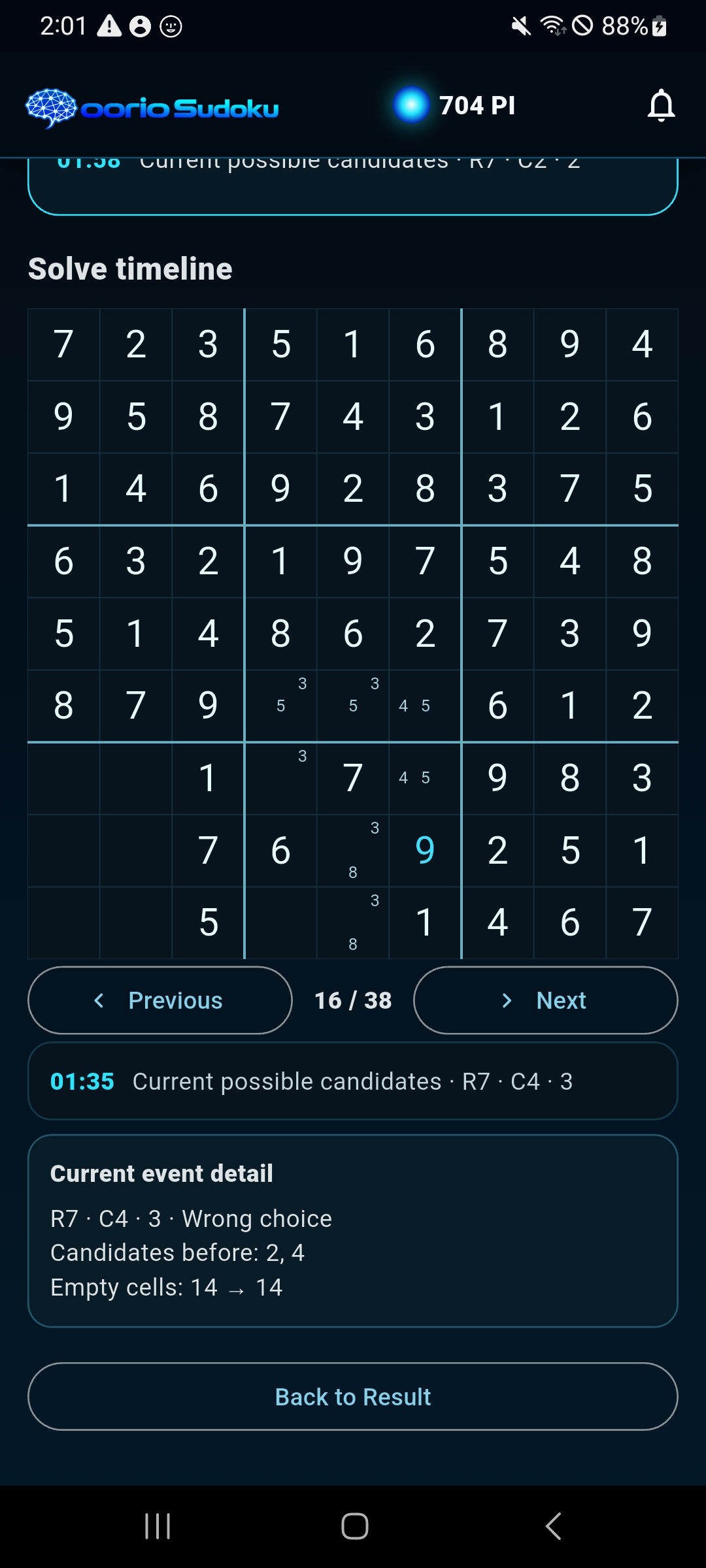
Walk through placements, mistakes, notes, erasures, Undo, and Redo in time order. See the selected event, its candidates, and the changing grid to understand hesitation and recovery that a final score cannot show.
The solve Timeline is a record of one game; accumulated Progress describes patterns across many puzzles. Keeping them separate prevents one success or one mistake from standing in for your overall ability.
REASONING JOURNEY
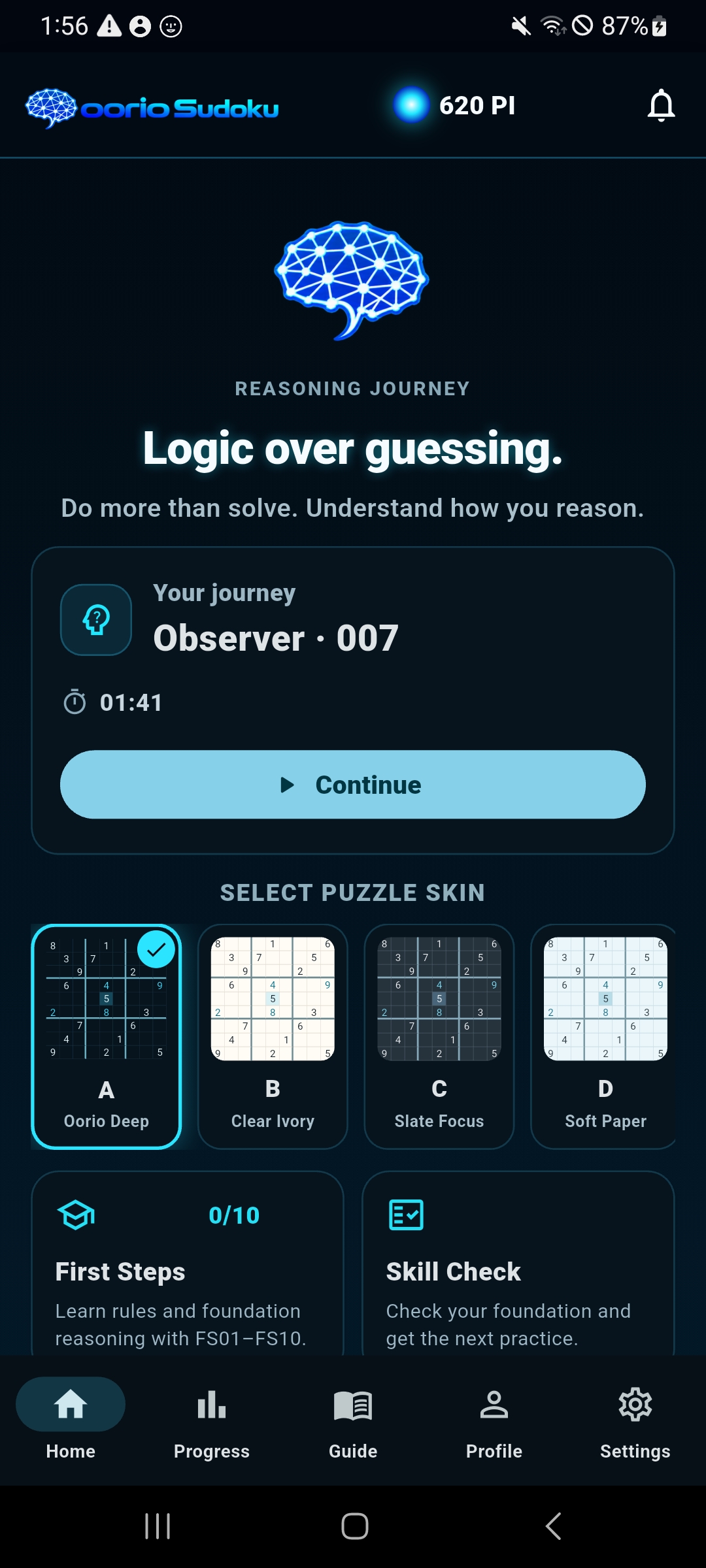
Start with row, column, and 3×3-box rules, then move into candidates, Naked Single, Hidden Single, and other foundational reasoning.
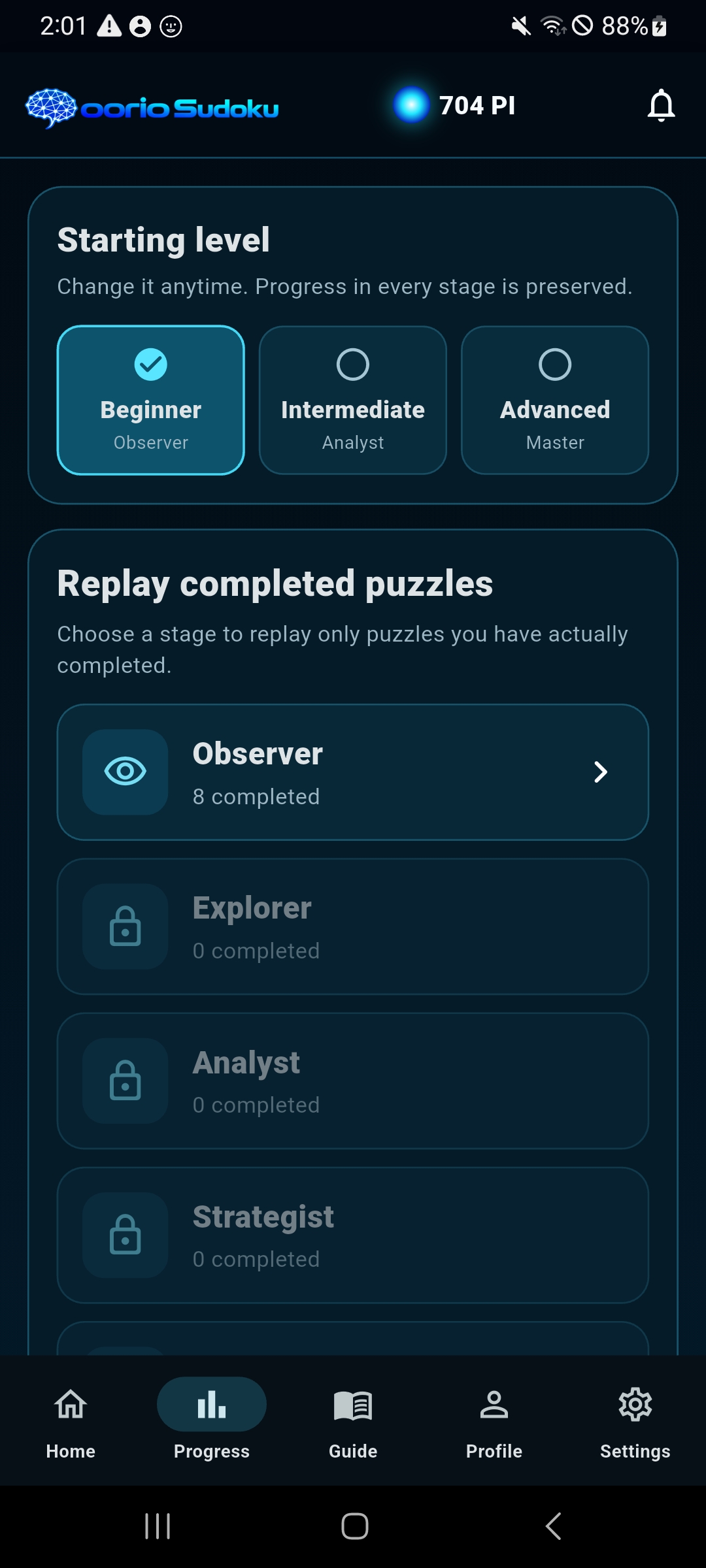
Progress from Observer toward higher stages. Changing your starting level does not erase completed progress, and completed puzzles remain available for replay.
Experienced solvers can review candidate management, corrections, recovery after mistakes, independent solving, and techniques supported by actual evidence.
TECHNIQUE LIBRARY
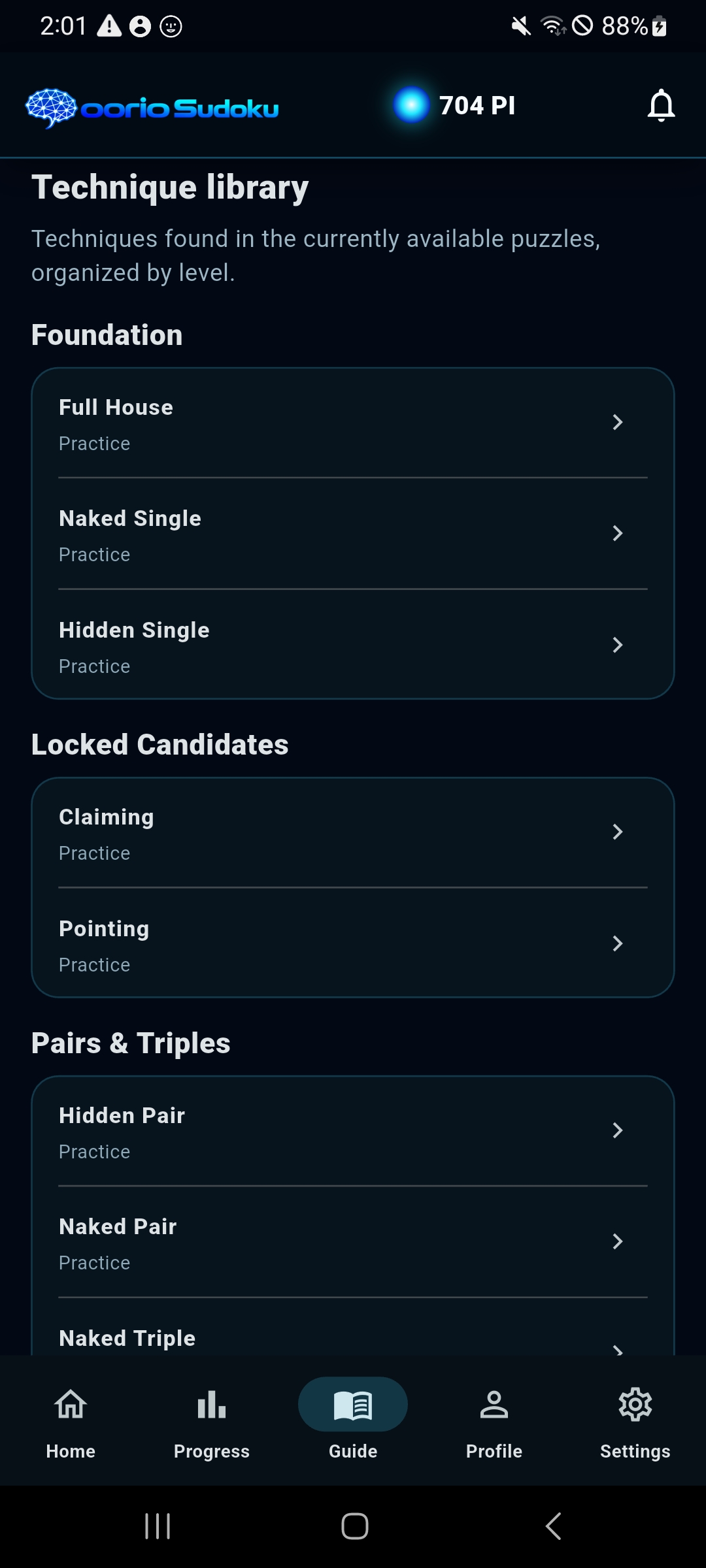
Explore Full House, Naked Single, Hidden Single, Claiming, Pointing, Hidden Pair, Naked Pair, Naked Triple, and more in staged practice.
Completed puzzles distinguish techniques evidenced by recorded actions from verified techniques present in the puzzle.
PI & PROGRESS
PI (Puzzle Index) reflects puzzle stage and number together with accuracy, independent solving, candidate control, and solve quality.
Check your current stage, accumulated PI, completed puzzles, and growth-evidence puzzles, then look for longer-term patterns in accuracy, independence, candidate control, recovery, and technique mastery.
FOR DIFFERENT AGES
Repeat a clear cycle: check constraints, compare candidates, eliminate options, decide, and verify instead of jumping straight to the answer.
Use a short puzzle as focused, self-directed logical problem solving.
Work with familiar numbers and clear rules at a comfortable pace, using the puzzle as an activity in observation, comparison, and judgment.
FOCUSED SUDOKU TOOLS
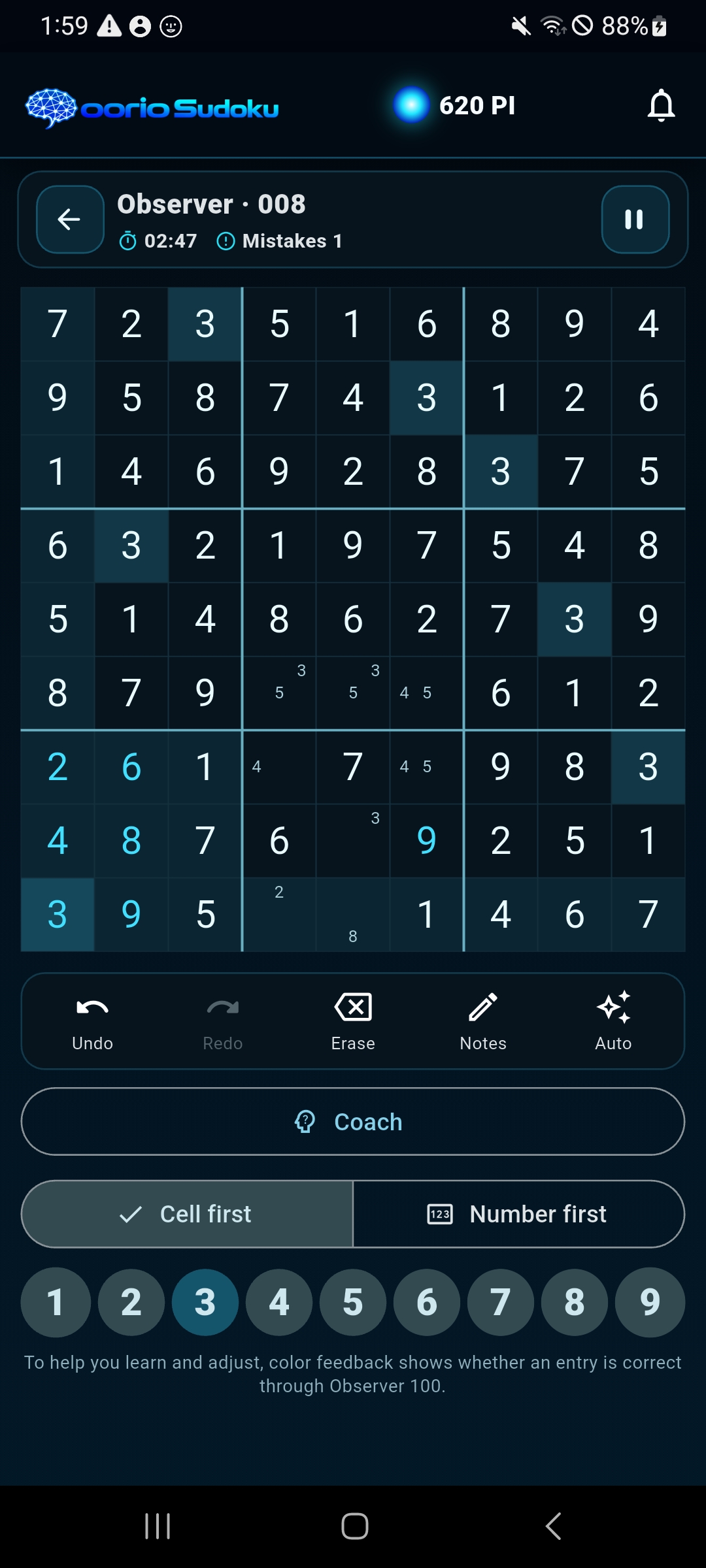
Choose the input order that feels natural to you.
Manage candidates manually or use Auto Candidates to see possibilities quickly.
Use Undo, Redo, and Erase to organize the solve and revisit earlier decisions.
Coach points toward the next logical clue rather than simply revealing the answer.
Choose among oorio Deep, Clear Ivory, Slate Focus, Soft Paper, and other readable puzzle skins.
Start at a level that fits your experience while keeping your progress.
oorio Sudoku is not a medical device or a program for preventing, diagnosing, or treating cognitive conditions, and it does not guarantee specific cognitive benefits.
Revisit wrong placements, narrowed candidates, recoveries and turning points with the board as it looked then.
Review accuracy, independence, candidate control, solve quality, corrections, recovery and Coach use.
Move through Observer, Explorer, Analyst, Strategist, Master and Grandmaster without losing completed progress.
Separate what your actions demonstrate from techniques verified in the puzzle; do not invent thoughts the app could not observe.
LOGIC OVER GUESSING
Sudoku begins with simple rules, but a strong solve is a chain of observation, comparison, elimination, and verification. oorio Sudoku connects that hidden process to Key Decision Scenes, detailed analysis, the solve Timeline, Reasoning Journey, PI, and Progress.